
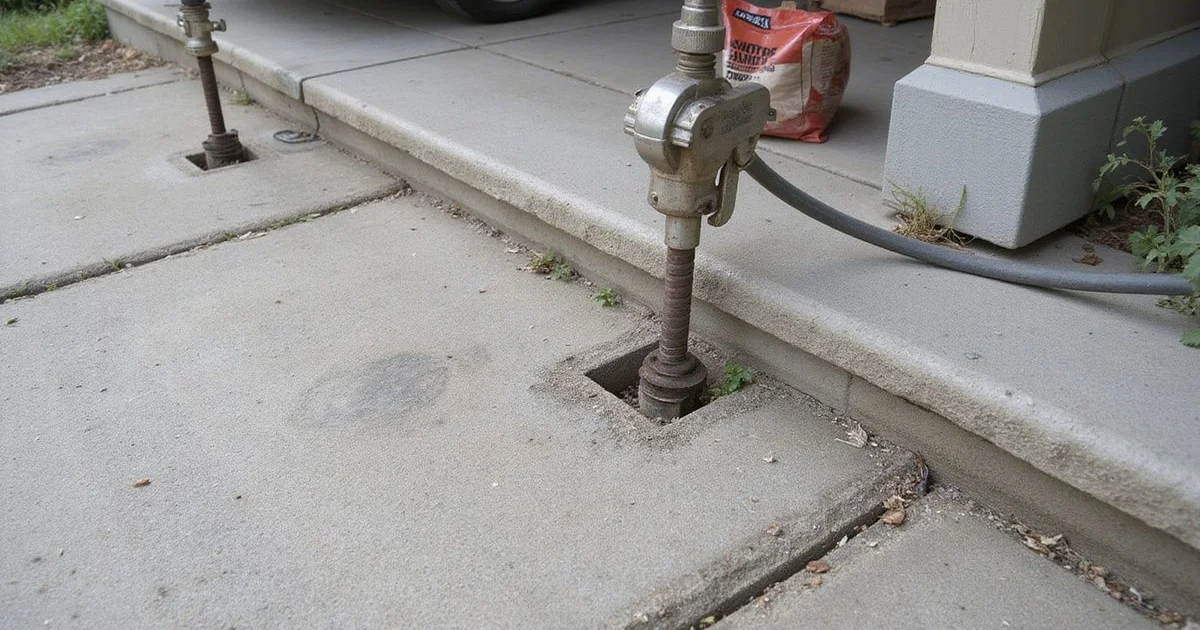
Two ways to raise the same slab
Both methods lift a settled concrete slab by introducing material underneath it through holes drilled in the surface. They differ in what that material is, and the differences have practical consequences.
Neither is a trick, and neither is obsolete. Here is how they compare.
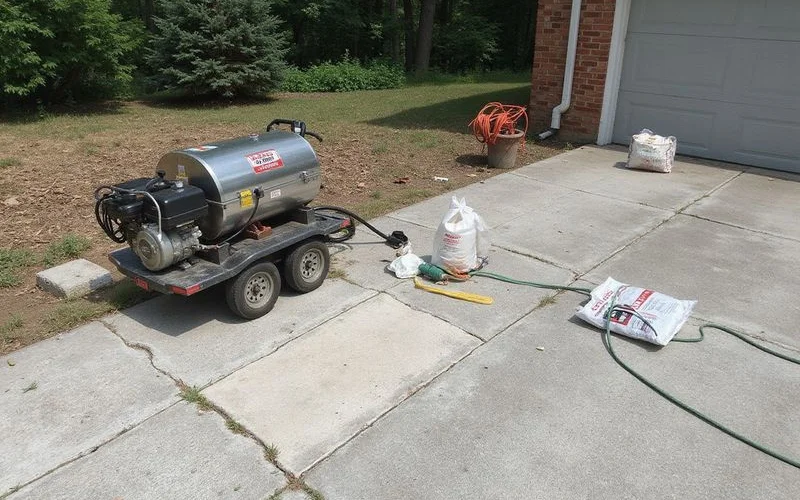
Mudjacking
A cementitious slurry — typically a mix of soil, sand, cement, and water — is pumped through holes drilled in the slab. The slurry fills the void and, as pressure builds, raises the slab.
Port size: larger, commonly around one to two inches, and more visible after patching.
Weight: the slurry is heavy. It adds load to soil that already failed to support the slab, which is a consideration on soft or previously washed-out ground.
Cure: longer before full loading, particularly under vehicle traffic.
Reach: the material is viscous and does not travel far from the injection point, so more ports are typically needed.
Cost: material cost is generally lower.
Polyurethane foam
A two-component polyurethane is injected through small ports. It reacts and expands, filling voids first and then generating lift as it meets resistance.
Port size: small, commonly around the diameter of a pencil, and less visible after patching.
Weight: lightweight. It adds negligible load to the underlying soil.
Cure: rapid. Most residential surfaces return to service the same day.
Reach: the expanding foam travels into voids and irregular spaces more readily than slurry.
Water resistance: cured polyurethane does not wash out the way a cementitious slurry can where water continues to move underneath.
Cost: material cost is higher, though the smaller crew requirement and faster completion offset some of it.
Side by side
| Consideration | Mudjacking | Polyurethane foam |
|---|---|---|
| Port size | Larger, more visible | Small, less visible |
| Added weight on soil | Significant | Negligible |
| Return to service | Longer | Usually same day |
| Fine control of lift | Harder | Easier |
| Void reach | Limited | Good |
| Behaviour with ongoing water | Can erode | More resistant |
| Material cost | Lower | Higher |
Which we generally use, and why
For most residential flatwork in Middle Tennessee, polyurethane foam is our default. The reasoning is practical: small ports look better on a driveway or walkway, the lightweight material does not add load to soil that already failed, and same-day return to service matters to people who need to park a car.
That is a default, not a dogma. There are situations where slurry is appropriate, and a contractor who works only in one method will tell you their method suits everything.
The point both methods share
Neither addresses why the void formed.
If water has been washing fines out through joints and cracks, it will keep doing so. That is why joint sealing usually accompanies a lift, and why the downspouts and grading nearby are worth a look while the crew is there.
A lift with the cause corrected is durable. A lift without it has a timer on it, and the material used barely affects the countdown.
When neither is the answer
Slabs that have broken into many pieces, crumbled, or deteriorated through their thickness are not lifting candidates by either method. Our guide on concrete leveling versus replacement covers where that line sits.
The concrete leveling page explains our eligibility assessment and what drives the cost of a lift.