
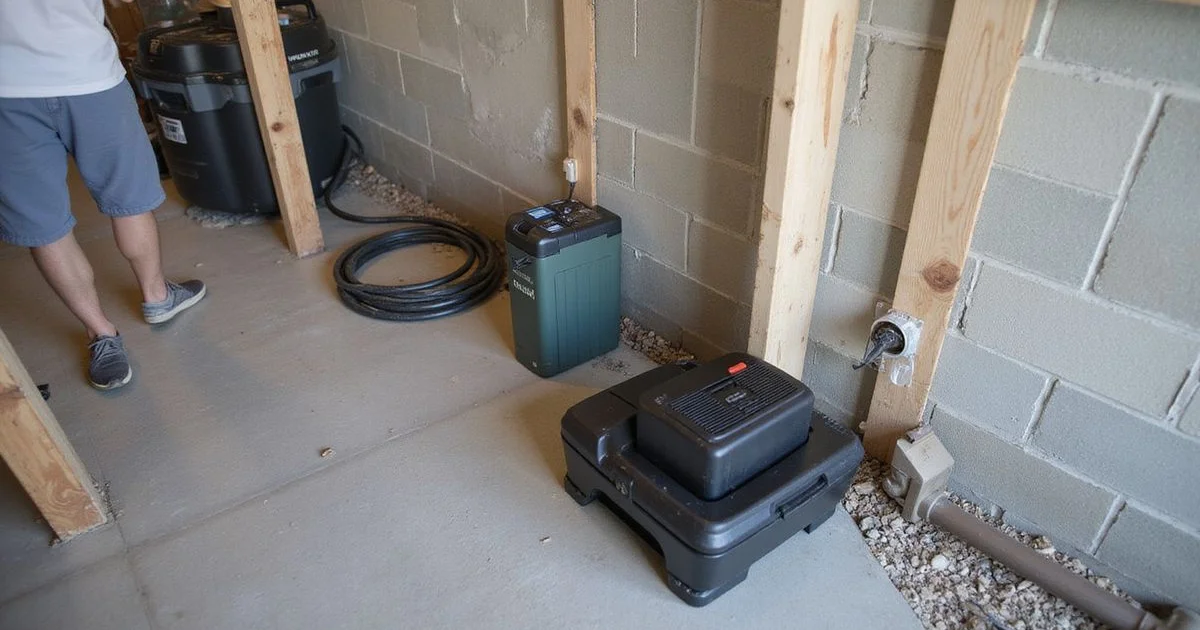
The problem a backup solves
Middle Tennessee storms bring heavy rain and, frequently, power outages. Those two things arrive together, which is the worst possible combination for a house that depends on a sump pump.
A battery backup exists to cover that overlap. It is not a luxury item in a home where a flooded basement would cause real damage.
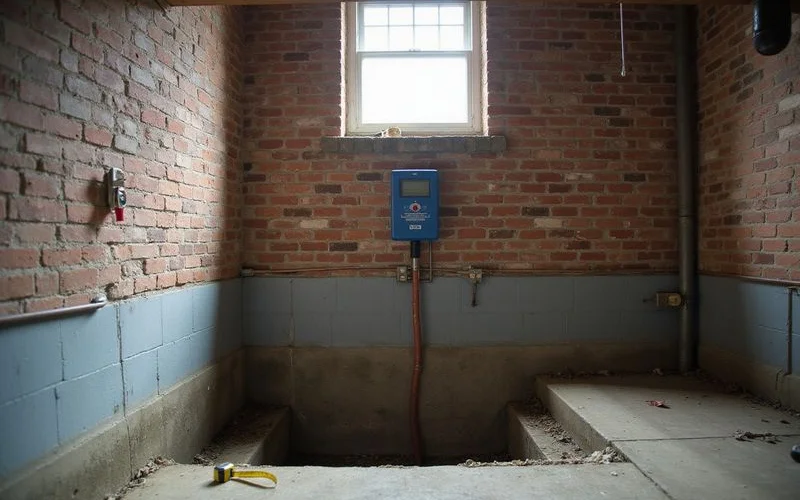
How the system works
A secondary pump sits in the same basin as the primary, usually mounted slightly higher so it only engages when the water rises past the primary’s normal operating range.
A deep-cycle battery powers it, kept charged by a charger and controller connected to house power. When mains power fails or the primary pump does not clear the water, the controller switches the backup on and it runs from the battery.
The controller typically also monitors battery condition and triggers an alarm on fault conditions.
Why AGM batteries
Absorbed glass mat batteries are commonly used for this application. They are sealed, so they do not require electrolyte topping up and are safer in a living space, and they tolerate the deep-discharge cycles a backup demands better than a starting battery would.
Runtime depends on capacity and on how hard the pump has to work — how much water is arriving, and how high it has to lift it.
What alarms and monitoring add
A backup that quietly failed six months ago is not a backup.
Most systems include an audible alarm for high water, low battery, or a fault condition. Some offer remote monitoring, which sends an alert to a phone.
For a property that is sometimes unoccupied — a second home, a rental, or simply a house you leave for a week — monitoring is where a fair amount of the value sits.
The honest limits
A backup buys time. It does not provide indefinite protection.
Runtime is finite. A sustained multi-day outage with continuous heavy inflow will exhaust a battery. Battery capacity degrades with age, and a five-year-old battery does not deliver what a new one did. And if the primary pump has failed rather than lost power, the backup is carrying the full load rather than supplementing.
None of that is an argument against having one. It is an argument against treating it as a reason to skip maintenance on the primary.
Alternatives and complements
Water-powered backup pumps run on municipal water pressure and require no battery, which removes the runtime limit. They use a significant volume of water in operation and need adequate supply pressure, and they are not suitable for every property.
Generators cover the whole house rather than just the pump, which is a different scale of investment and a different problem being solved.
A second primary pump on a separate circuit addresses pump failure but not a power outage.
Maintenance that keeps it real
Test the backup at least annually by disconnecting mains power to the system and confirming it takes over.
Check the battery’s condition and age, and replace it on a schedule rather than after a failure. Inspect terminals for corrosion. Confirm the alarm sounds when tested.
And test the primary pump at the same time, because the backup is only as useful as the system it sits in. Our guide on signs your sump pump is failing covers what to check.
Where it fits in the system
A backup is one component of a functioning drainage arrangement. Collection, pump capacity, check valve, and discharge routing all matter as much. Our guide on how interior drainage and sump systems work explains the whole chain, and the sump pumps page covers installation, sizing, and backup options.