
The largest controllable water source at your house
A roof concentrates an enormous volume of water into a handful of downspouts. Every rain event delivers that volume to a few specific points around your foundation.
Where those points discharge is one of the few genuinely controllable variables in the whole foundation-and-water picture, and it is the cheapest one to change.
Surface extensions
The simplest option: a length of downspout pipe or a flexible extension carrying water away from the foundation.
Advantages. Cheap, quick, reversible, and doable by a homeowner in an afternoon.
Limitations. They get moved by mowing and foot traffic. They are visible. On a tight lot there may be nowhere to discharge without crossing a walkway or a property line. And flexible accordion extensions crush, kink, and disconnect.
Still: a surface extension in place today beats a buried line you have been meaning to install for two years.
Buried conductor lines
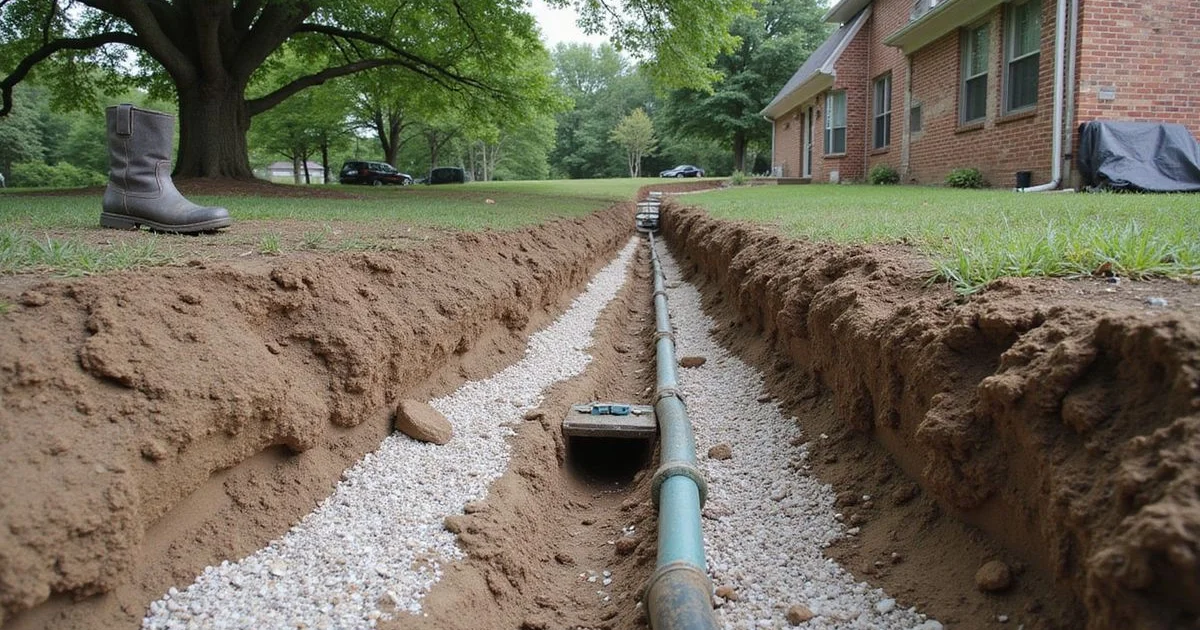
Solid pipe running underground from the downspout to a distant discharge point.
Advantages. Invisible, not disturbed by mowing, and capable of carrying water a long way to a properly chosen outlet. This is the durable version of the fix.
Requirements. Adequate fall from the downspout to the outlet, correct pipe sizing for the roof area being drained, solid rather than perforated pipe — perforated pipe leaks water along its length, which defeats the purpose — and a cleanout or accessible connection for maintenance.
Failure modes. Crushed by vehicles or settlement, clogged with debris from unguarded gutters, and separated at joints. These failures are invisible from the surface, which is why testing with a bucket of water occasionally is worthwhile.
Pop-up emitters
The outlet for a buried line. A hinged cap sits flush with the lawn and opens under flow pressure, releasing water and closing again afterwards.
Advantages. No open pipe end, mowable, and unobtrusive.
Requirements. It must sit lower than the inlet, and it must be somewhere that water leaving it can actually drain away. An emitter in the lowest part of the yard will surcharge and back up.
Maintenance. They get buried by grass growth and mulch. Check they are visible and functional.
Catch basins
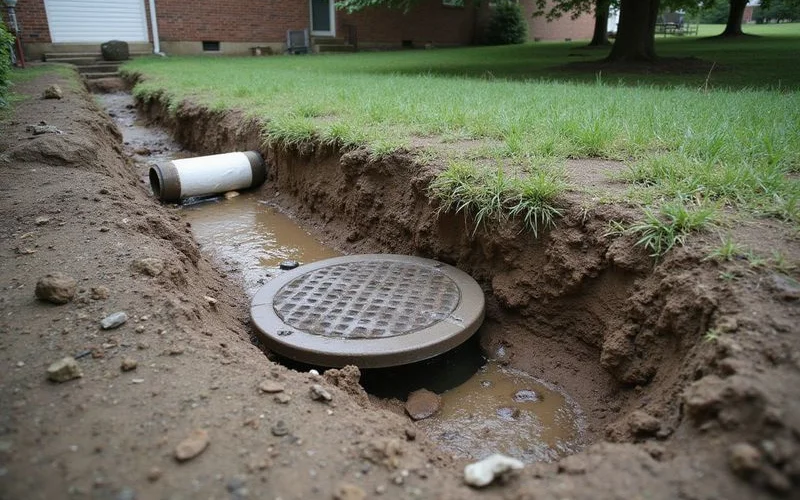
A grated box set at a low point, collecting surface water and routing it into a piped run.
Where they help. Areas that collect water and cannot practically be graded away — a low corner, a spot beside a driveway, the base of a slope.
What they need. Adequate sizing for the area draining to them, connection to a pipe with fall to a viable outlet, and periodic clearing of the grate and the silt trap.
Where they are oversold. A catch basin in an area that could simply be regraded adds a maintenance item for no benefit.
The rule that governs all of it
Every component above collects water. None of them disposes of it. The discharge point decides whether the system works.
Water needs to end up far enough from the foundation, on ground that carries it away, at a point that does not create a problem for you or a neighbour, and in a way that still functions during the heaviest events rather than only typical ones.
Where this sits in the bigger picture
Roof water management is step one on almost every wet-foundation property we look at. It is cheap, it is quick, and it removes the largest concentrated source.
Our guide on foundation and water-system maintenance covers the seasonal routine that keeps it working, and the drainage solutions page covers the full range of work when the roof is only part of the story.