
Most foundation problems start as maintenance problems
The mechanisms that damage foundations are overwhelmingly water-related, and water behaviour around a house is largely under your control. Gutters, downspouts, grading, and drainage all decide where several thousand gallons go each time it rains.
An hour or two a year on the items below prevents a meaningful share of what we get called out to look at.
Gutters and downspouts
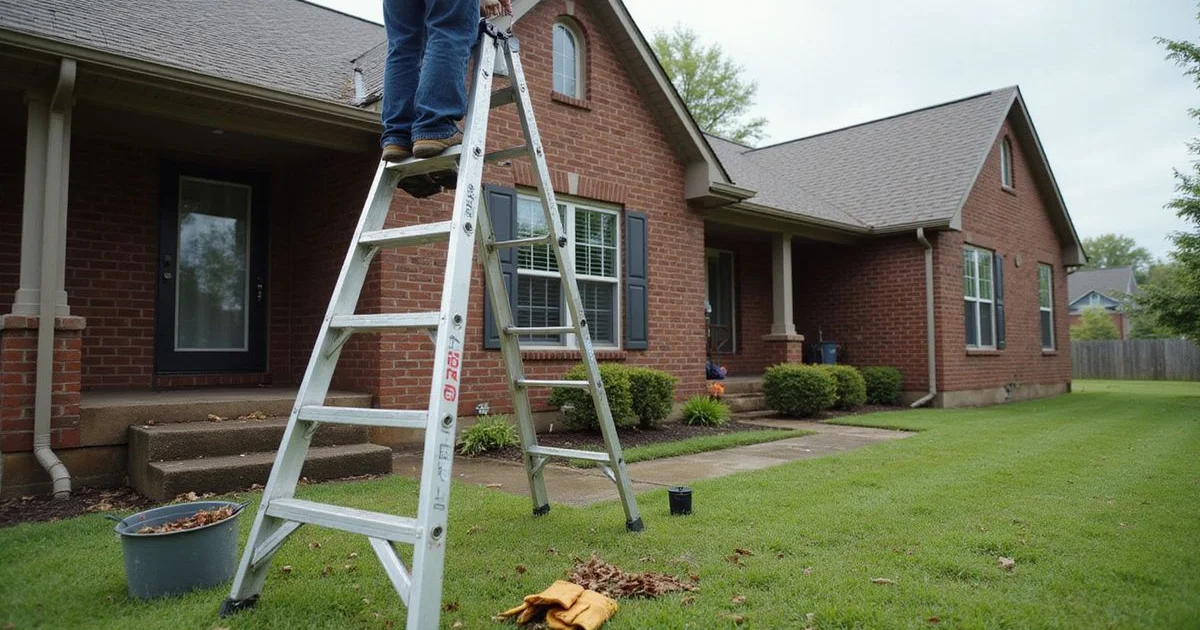
Clear gutters twice a year, more often under heavy tree cover. A blocked gutter overflows at the fascia and delivers roof water straight down the wall into the backfill zone — precisely where you least want it.
Check that downspouts are connected, that extensions are still in place, and that buried conductor lines actually flow. Pour a bucket of water into each downspout and walk to the outlet to confirm it arrives. Lines crush, clog with debris, and disconnect at joints, and nothing about that is visible from the surface.
Confirm outlets are clear. Pop-up emitters get buried by mulch and grass over a couple of seasons.
Grading and surface water
Walk the perimeter after rain. Look for pooling against the foundation, soft ground that stays saturated, erosion tracks, and any area where ground falls toward the house rather than away.
Watch mulch and soil levels against masonry. Beds get topped up year after year and can end up holding moisture against the wall or bridging the point where siding starts.
Check window wells for standing water and clear debris from their drains.
Our drainage solutions page covers what to do when a walk turns up something that regrading alone will not fix.
Sump pump testing
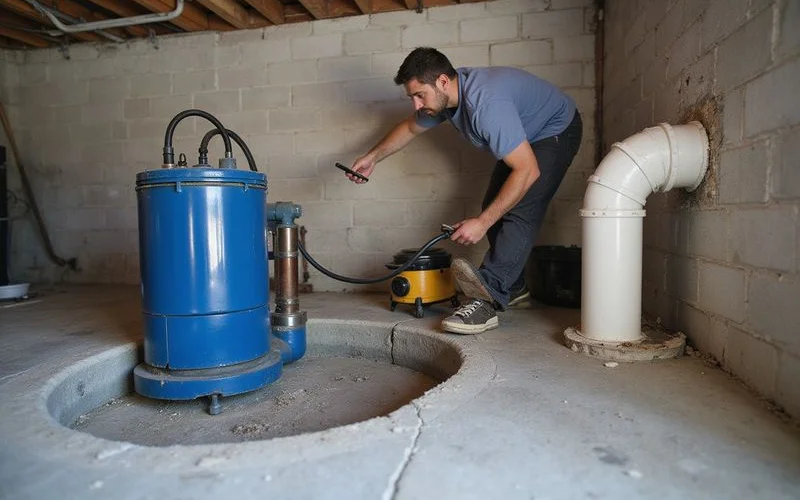
Test by lifting the float by hand or pouring a bucket of water into the basin. Confirm the pump starts, moves water, and shuts off cleanly.
Then walk outside and confirm water is arriving at the discharge point. A pump that cycles perfectly into a blocked line has done nothing useful.
Clear sediment from the basin when it builds up. Check the check valve is holding, which shows as the basin refilling immediately after shutoff if it is not. If you have a battery backup, test it and check the battery’s condition and the alarm.
Do all of this before wet seasons, not during them. Our sump pumps page covers the components in more detail.
Crawl space and basement moisture monitoring
If your crawl space is encapsulated, check the humidity gauge periodically. A reading that has drifted upward means something changed: a dehumidifier fault, a liner tear, a reopened vent, or a new water source.
If it is not encapsulated, look for standing water, torn plastic, condensation on framing, and any musty odour reaching the living space.
In a basement, watch for efflorescence, new staining, and dampness at the wall-floor joint after rain.
An inexpensive humidity gauge in either space is one of the better investments a homeowner can make, because it turns a vague sense of “it feels damp” into a number that can be tracked.
Crack monitoring
Keep a simple record. Photograph known cracks once a year with a date and a scale reference. Mark crack ends with a pencil and date the mark.
If you want precision, a plastic crack monitor mounted across a crack shows displacement on a grid for very little money.
Twelve months of that record is worth more than any description you can give an evaluator over the phone.
A seasonal rhythm for Middle Tennessee
Autumn, before the wet months. Clear gutters, check downspout lines and outlets, walk the grading, test the sump, confirm backups.
Winter. Watch for water entry during sustained rain and note where it appears. Check that exposed discharge lines are not frozen.
Spring. Clear gutters again after the last leaf drop and pollen. Recheck grading after freeze-thaw. Look for new cracking after a wet period.
Summer. Watch crawl space humidity through the humid months. Check for condensation. Note whether doors that stick are doing it seasonally.
When maintenance is not enough
If you are doing all of the above and still seeing water entry, progressive cracking, or floor movement, the maintenance was worth doing but the cause is elsewhere. That is the point at which an evaluation earns its cost, because you have already ruled out the easy explanations. Our guide on foundation warning signs sets out which observations justify booking one.