
Two credible methods, different conditions
Both of these stabilize a bowing basement wall. Both work. Which one belongs on your wall depends on measurements and site conditions rather than on which one a company markets harder.
Here is the comparison, followed by the factors that actually decide it.
Side by side
| Consideration | Carbon fiber | Wall anchors |
|---|---|---|
| How it resists | Bonded tensile reinforcement on the interior face | Rod tied to an anchor plate in stable exterior soil |
| Displacement suited to | Limited | Greater |
| Exterior access | Not required | Required |
| Position recovery | No | Sometimes, gradually |
| Visual impact inside | Low profile, can be finished over | Visible interior plates |
| Yard disruption | None | Excavation at each anchor |
| Adjustability later | No | Yes, tension can be adjusted |
Carbon fiber in more detail
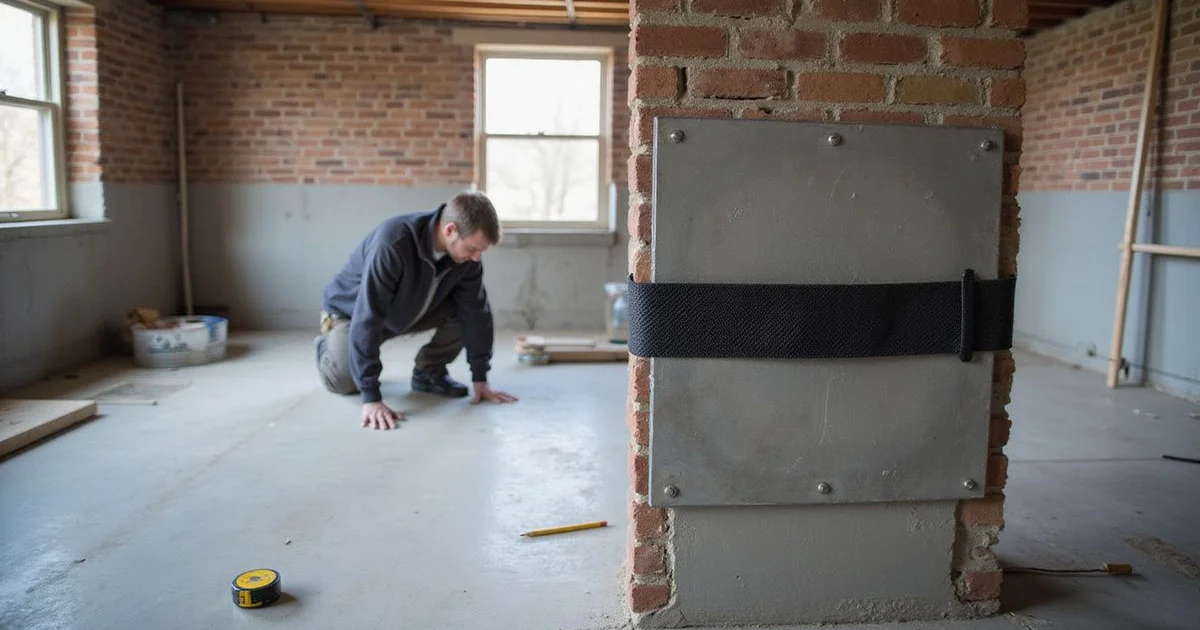
High-strength carbon fiber straps are bonded to a prepared wall face with structural epoxy. They add tensile capacity that masonry does not have, resisting the bending that produces inward deflection.
Its strengths: no exterior excavation, no yard damage, low profile so the basement stays usable, quick installation, and it can be finished over.
Its requirements: sound masonry with a surface that can be properly prepared. Bond is everything, and a deteriorated or spalling wall face is a poor substrate.
Its limits: it holds a wall where it is. It does not recover position, and beyond a certain measured displacement it is not the right tool.
Wall anchors in more detail
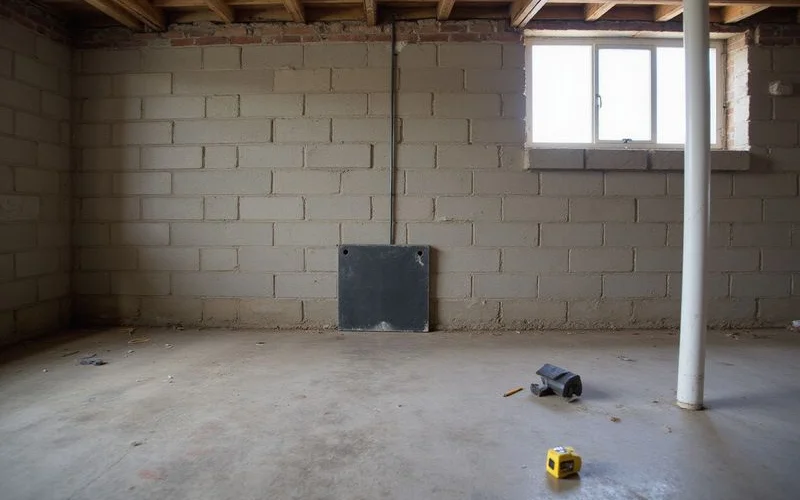
A steel rod passes through the wall to an anchor plate set in stable soil out in the yard, with a plate on the interior face. Tightening the assembly applies resisting force against the wall.
Its strengths: handles greater displacement, can be re-tensioned over time, and — as exterior soil conditions allow, for example after a dry period — may recover some position gradually.
Its requirements: accessible soil at the designed distance from the wall. That distance is not negotiable; the anchor must sit in soil that is not itself part of the mass pushing on the wall.
Its limits: access frequently rules it out. Driveways, patios, additions, neighbouring structures, and property lines all intervene. Installation disturbs the yard, and interior plates remain visible.
What actually decides it
Measured displacement. The first input. Limited movement keeps carbon fiber in play; greater movement usually takes it out.
Exterior access. Present or absent. This alone decides many projects, particularly on tight urban lots in Nashville.
Masonry condition. Sound face for bonding, or deteriorated. A wall with crumbling block is a poor carbon fiber candidate regardless of displacement.
Wall construction and height. Block versus poured, and how much soil the wall retains.
Whether recovery matters to you. If regaining some position is a genuine objective, that points toward anchors.
Basement use. A finished basement or one you plan to finish changes the weight given to visual impact.
The third option worth knowing about
Steel channel bracing handles displacement beyond carbon fiber’s range without needing exterior access. The beams project into the room, which matters in a finished basement, but on constrained sites with significant movement it is frequently the practical answer.
Our guide on how bowing basement walls are stabilized covers all three installation processes.
Neither removes the cause
Whichever method is installed, the soil outside keeps doing what it was doing. Expansive clay still swells; saturated backfill still exerts pressure.
Drainage correction belongs alongside the structural work, and a proposal that omits it is describing part of a project. The basement wall repair page explains how we assess both together, starting with the measurement that decides the method.