
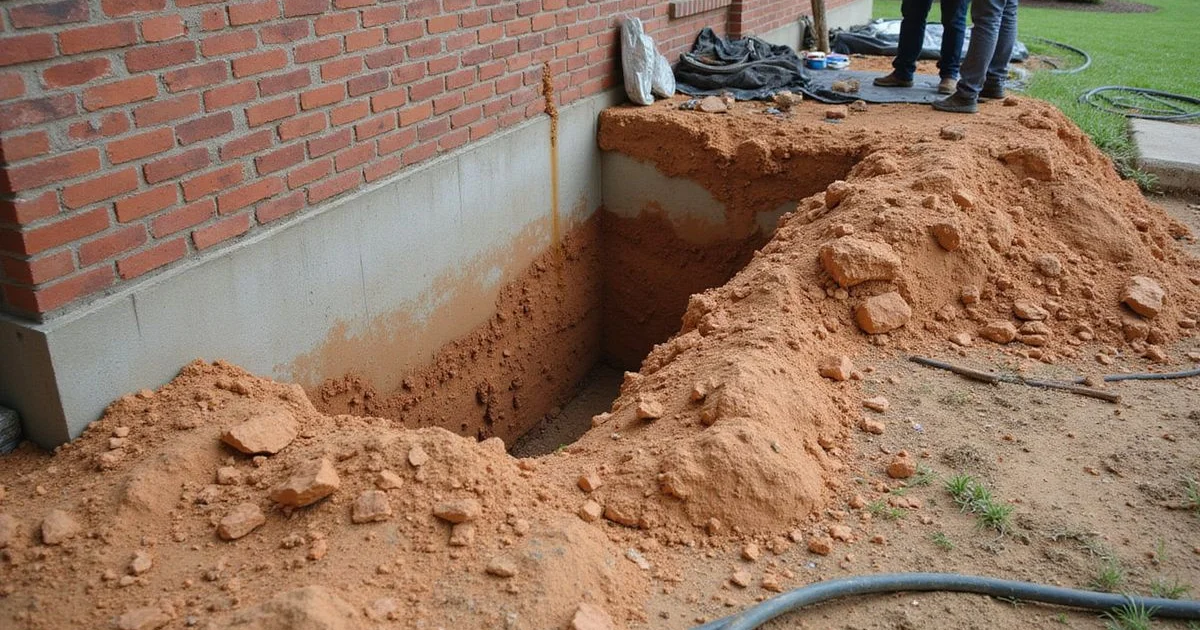
The forces acting on a basement wall
A basement wall is a retaining structure. Soil pushes against it continuously, and the wall was designed to resist a certain amount of that push.
Three things increase the load beyond the design assumption: water in the soil, soil that expands, and additional loads placed near the wall. In Middle Tennessee, the first two do most of the damage.
At-rest earth pressure: the baseline
Soil against a wall exerts pressure proportional to its depth and density. This is normal, constant, and designed for. A properly built wall handles it indefinitely.
The pressure increases with depth, which is why walls fail in the middle or lower portion rather than at the top, and why taller basement walls carry more load than shallow ones.
Hydrostatic pressure: water added to the equation
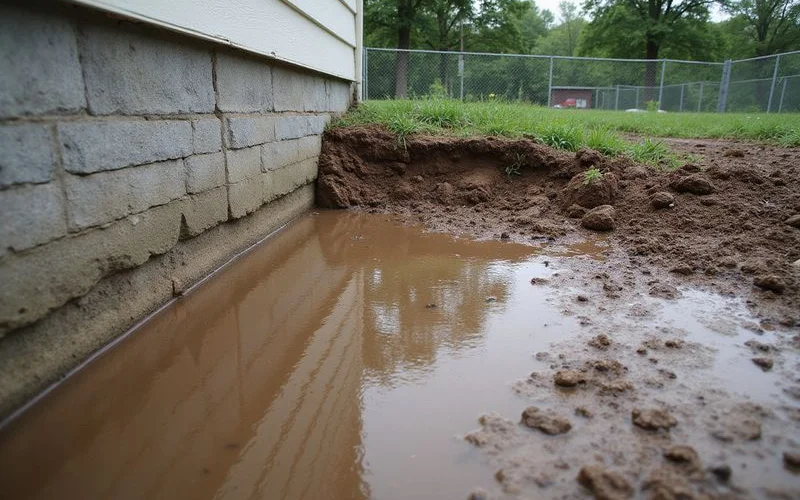
When soil becomes saturated, water in the pore spaces exerts its own pressure against the wall, on top of the soil’s.
Water is heavy and it transmits pressure in all directions. A saturated backfill zone can therefore load a wall substantially more than the same soil would when drained.
This is why drainage matters structurally rather than just cosmetically. Keeping the backfill zone from saturating reduces the load the wall has to resist.
Expansive clay: pressure from swelling
Middle Tennessee has a great deal of high-plasticity clay, and clay of this kind changes volume with moisture content. It swells as it takes on water and shrinks as it dries.
When clay backfill swells against a basement wall, it does not simply get heavier — it expands, and the wall is in the way. That generates pressure directly.
The result is a seasonal cycle. Wet spring, pressure rises. Dry August, pressure eases. Many walls cycle this way for years, opening and partially closing a crack, until the accumulated movement becomes visible.
Surcharge loads
Anything placed near the top of the wall adds to what it carries. A driveway, a parked vehicle, a heavy retaining structure, or fill added during landscaping all count.
Vehicle loading close to a basement wall is a surprisingly common contributor and an easy one to overlook.
How pressure produces movement
Under sustained lateral pressure, a block wall bends. Because masonry has limited tensile strength, it cracks along the weakest line — typically a horizontal mortar bed near mid-height, where bending stress peaks.
Once cracked, the wall hinges at that line and continues moving inward under continuing load. Progression follows the water and clay cycle: each wet season adds a little more.
Poured walls resist bending better and tend to show different patterns, often displacement at a cold joint or tilting from the top.
What a damp wall does and does not tell you
Dampness means water is present at or in the wall. That is all.
It does not establish that hydrostatic pressure is high, that the wall is failing, or that structural work is needed. Many damp basements have perfectly plumb walls, and the correct response is drainage and waterproofing rather than stabilization.
Conversely, a dry basement does not prove the pressure is low. A wall can deflect under swelling clay with very little water ever reaching the interior.
The evidence for structural concern is measured deflection and progression, not moisture.
Reducing the load
This is the part worth acting on regardless of whether stabilization is needed.
Clear gutters and extend downspouts well away from the foundation. Establish a grade that falls away from the house. Keep beds and mulch from holding water against the wall. Where the site produces more water than surface measures can manage, exterior drainage intercepts it. Our guide on interior versus exterior basement drainage compares those two approaches.
Reducing the load extends the life of the wall and, where stabilization has been installed, reduces what the reinforcement has to carry for the next several decades.
The basement waterproofing page covers the water management side, and basement wall repair covers the structural side. On a wall with both problems, the honest scope includes both.