
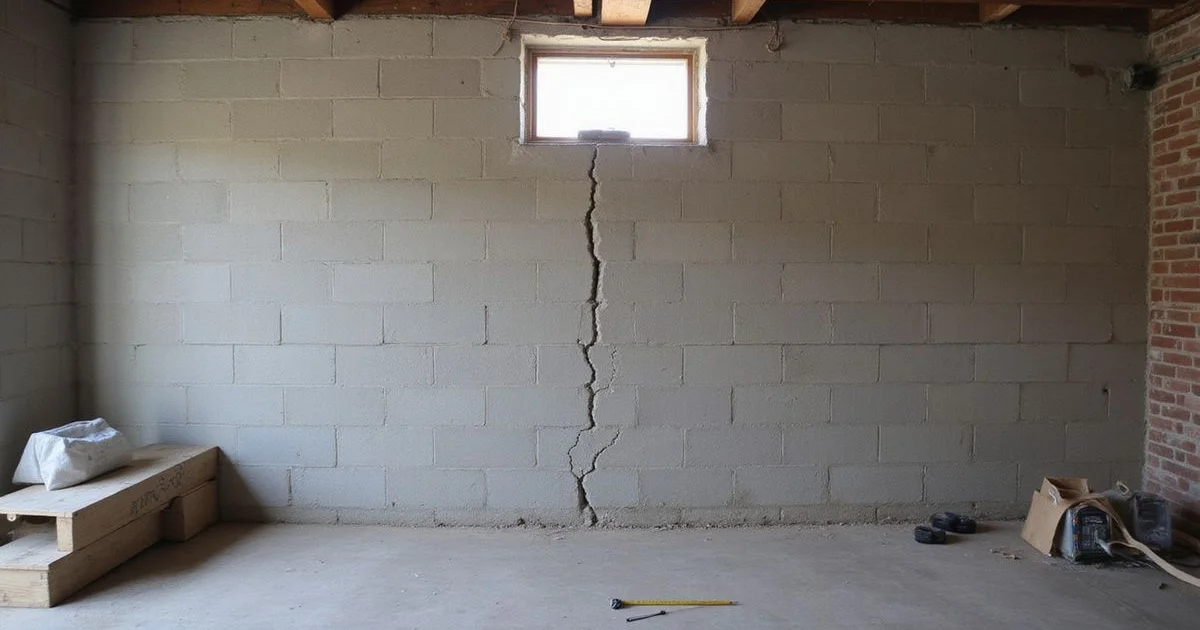
Crack shape is the first piece of evidence
Basement walls fail along predictable lines, and the orientation of a crack tells you something about the force that produced it. It is not a diagnosis, but it is the fastest way to know whether you should be relaxed or attentive.
Here are the four patterns you are likely to see, and what each typically reflects.
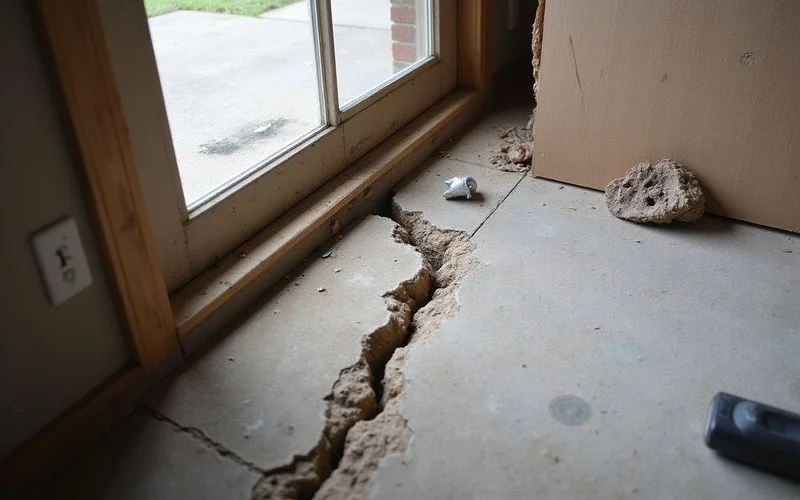
Vertical cracks
Where they appear: most commonly in poured concrete walls, often running from the floor upward, sometimes the full height.
What they usually reflect: concrete shrinkage during curing. Concrete shrinks as it hydrates, and a wall restrained at its ends develops tension that relieves itself as a crack. This is extremely common and frequently benign.
When to pay attention: if the crack is wide, if one side sits proud of the other, if it is growing, or if it is admitting significant water.
Most likely conversation: water sealing, if it leaks. Structural work is less commonly indicated by this pattern alone.
Horizontal cracks
Where they appear: along a mortar bed in block walls, typically somewhere around mid-height; occasionally in poured walls.
What they usually reflect: lateral pressure from the soil outside, exceeding what the wall can resist in bending. This is the classic bowing-wall crack.
When to pay attention: essentially always. A horizontal crack deserves a deflection measurement against a straightedge or plumb line, and a record of whether it is changing.
Most likely conversation: stabilization, alongside drainage correction to reduce the load.
Stair-step cracks
Where they appear: block walls, following the mortar joints diagonally.
What they usually reflect: differential movement. One section of wall or footing has moved relative to another, and the wall has cracked along its weakest path.
When to pay attention: when the crack is wide, when blocks have displaced so one side sits proud, when it is progressing, or when the house shows companion symptoms above.
Most likely conversation: depends on the mechanism. Settlement points toward underpinning; lateral movement points toward stabilization.
Diagonal cracks
Where they appear: radiating from the corners of basement windows, doors, and other openings.
What they usually reflect: stress concentration at openings. Corners are where stress collects, and cracks start there under a range of conditions.
When to pay attention: width, progression, and displacement across the crack.
Most likely conversation: varies widely, which is why this pattern needs the most context.
Water signals versus structural signals
Alongside orientation, look for what the crack is doing.
Water signals: staining beside or below the crack, efflorescence, dampness at the wall-floor joint, wetting that appears after rain.
Structural signals: measurable inward deflection, displacement across the crack, mortar crumbling from the crack line, blocks visibly shearing, companion symptoms upstairs.
A crack can have one set, both, or neither. Both together usually means water is driving the movement, which is why our guide on hydrostatic pressure and basement walls is worth reading alongside this one.
What to measure
Width at the widest point. Length, with dated pencil marks at each end. Displacement across the crack — run a finger across it and note whether one side is proud. Wall plumb, using a straightedge or plumb line at the crack’s height.
Then repeat seasonally. A photograph with a date and a scale reference is the minimum useful record.
The next step
A single crack rarely justifies a project. A crack with measurable deflection behind it, or a crack that is demonstrably growing, does.
A basement wall repair evaluation measures the deflection, characterises the cracking, checks whether movement is active, and looks at the drainage conditions outside the wall — which is where the load usually originates.