
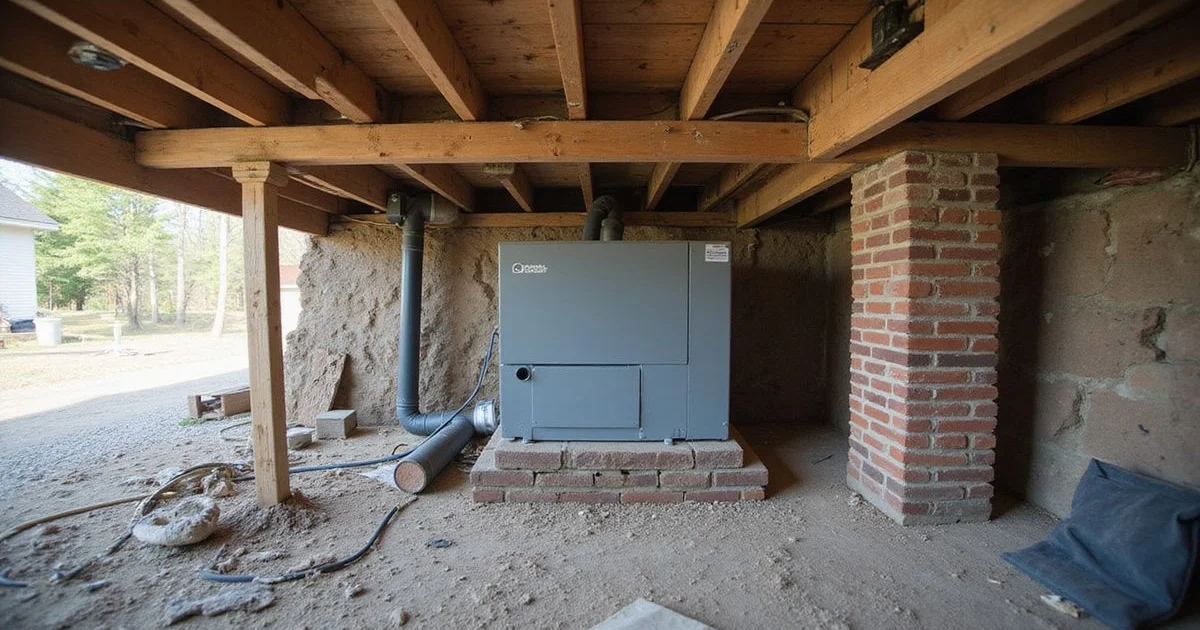
Why sizing matters here specifically
Middle Tennessee summers produce sustained high dew points. That means the air itself carries a substantial moisture load for months at a time, and a crawl space that exchanges air with the outside gets that load delivered continuously.
A dehumidifier that would comfortably manage a crawl space in a dry climate can run continuously here and still fail to hold a target. Sizing has to account for the local condition, not a generic chart.
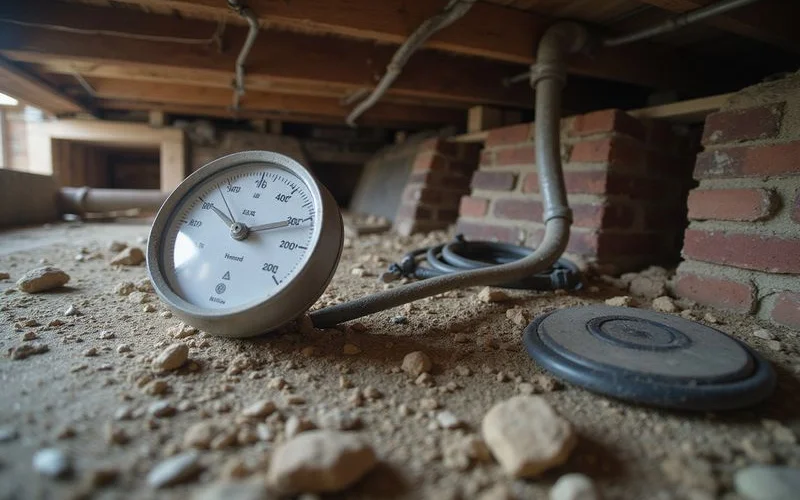
The target: under about 55% relative humidity
The reason for that number is wood. Wood moisture content tracks the relative humidity of the surrounding air, and holding air below roughly 55% keeps wood in a range where decay fungi struggle to establish.
It is also comfortable for the rest of the house, because crawl space air moves upward through the structure by stack effect.
A gauge in the crawl space lets you verify the system is doing what it was specified to do, which is the point of stating a target at all.
How capacity is chosen
Pints per day is the rating that matters — how much water the unit removes in 24 hours under stated conditions. Note that manufacturers rate at particular temperature and humidity conditions, and performance in a cool crawl space differs from performance at the rating conditions.
Space volume is the starting point: square footage multiplied by height.
Moisture load adjusts it. A sealed space with a good liner over the ground has a far lower load than an unsealed one with bare earth. Standing water, a high water table, or a plumbing leak all raise it dramatically — and all should be resolved rather than dehumidified.
Sealing quality is the multiplier people underestimate. Sealing the space is what makes modest capacity sufficient. Trying to compensate for poor sealing with a larger unit is expensive and usually disappointing.
Placement
Central where practical, so conditioned air distributes rather than drying one corner.
Raised off the liner on a stand or platform, protecting both the unit and the barrier.
Accessible for filter changes and servicing, because a unit nobody can reach is a unit nobody maintains.
With adequate clearance around the intake and discharge for airflow.
Condensate drainage
Gravity drain where a suitable drain point exists below the unit. Simplest and most reliable, with nothing to fail.
Condensate pump where gravity is not available. It lifts water to a discharge point. It is a mechanical device, which means it can fail, so a pump with an alarm or safety switch is worth specifying.
Either way, the discharge has to go somewhere sensible — not onto the liner, and not into the crawl space soil at the perimeter.
Controls and monitoring
Most units have an integrated humidistat. A separate gauge gives you an independent reading, which is useful when you want to know whether the unit’s own display is telling the truth.
Some systems offer remote monitoring. Whether that is worth it depends on how much you want to think about your crawl space, which for most people is not much — which is arguably the argument for it.
Maintenance
Check the filter periodically and clean or replace it. Confirm the condensate is draining. Check the humidity reading a few times a year, particularly through summer.
If the reading drifts up, something changed: a filter blocked, a drain line clogged, a liner torn by someone working under the house, or a new moisture source. That is diagnosable rather than mysterious, which is the practical value of building the system around a number.
Where this fits
Sizing is one part of a system. Our guide on what crawl space encapsulation includes covers the rest, and encapsulation versus a dehumidifier alone explains why the sealing comes first.
The crawl space encapsulation service page sets out how we assess a space and specify the system for it.