
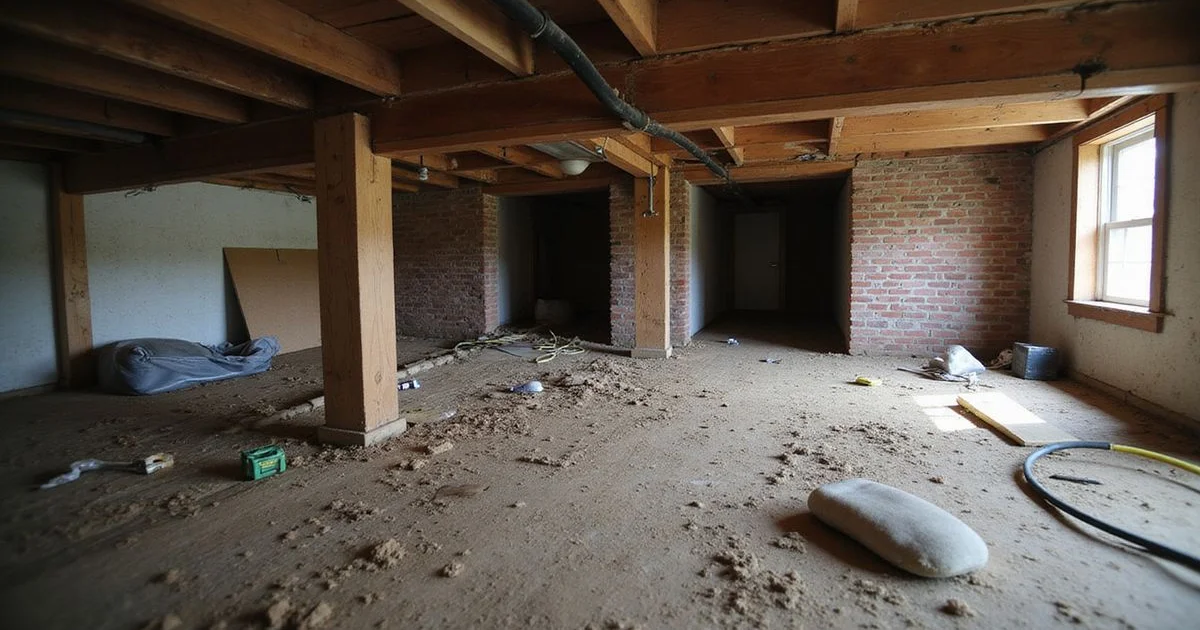
Two symptoms, one space
Homeowners usually arrive at this topic from one of two directions. Either the floor started to feel soft and uneven, or the house started to smell musty. Both trace to the same place, and often to the same underlying condition.
A crawl space in Middle Tennessee spends much of the year with high relative humidity. The framing above it absorbs that moisture, and wood that stays damp loses strength before it shows any obvious decay.
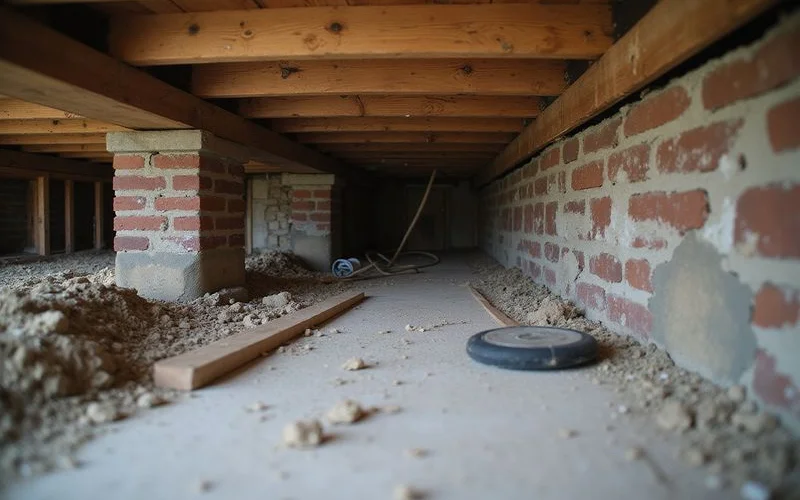
Where the moisture comes from
Ground vapor. A bare earth floor releases moisture continuously. Soil under a house is rarely dry, and that moisture goes somewhere: upward, into the air and the wood.
Humid outside air. This is the one that surprises people. In summer, warm humid air entering through open vents meets cooler surfaces underneath the floor and condenses on them. Venting, in this climate, often adds moisture rather than removing it.
Bulk water. Surface runoff entering the crawl space, groundwater seeping through walls, or a plumbing leak. Standing water is its own category and needs drainage, not just a liner.
Plumbing and duct condensation. Sweating cold water lines and uninsulated ductwork drip onto framing and the ground below.
What moisture does to the structure
Wood moisture content is the number that matters. Framing that stays persistently damp becomes hospitable to decay fungi, and those fungi break down the wood fibre that carries load.
The sequence is usually slow and quiet. Sill plates and rim joists go first because they sit closest to the masonry and the ground moisture. Girders that bear on block piers follow, particularly where they contact damp masonry. Joist ends and any member near a recurring water source come next.
By the time a floor above feels soft, the framing below has typically been compromised for years.
Why the floor bounces
Bounce and sag are related but not identical. Bounce is deflection under live load — you feel it when you walk. Sag is a permanent set the framing has taken.
The contributing conditions are usually some combination of joists spanning further than they comfortably can, girders sagging between widely spaced supports, original block piers that have settled or deteriorated, and framing that has lost capacity to decay or insect damage.
Moisture makes all four worse. It weakens the wood, it deteriorates the mortar in old piers, and it accelerates insect activity.
The air-quality side
The stack effect describes how air moves upward through a house: warm air rises and escapes at the top, and replacement air is drawn in from the lowest points, including the crawl space.
That means crawl space air ends up in your living space. Musty odour, seasonal allergy complaints that worsen at home, and hardwood floors that cup in August all connect back to what is happening under the floor.
This is the reason crawl space moisture is worth addressing even when the framing is currently sound.
What an evaluation examines
Support spacing and condition. Girder deflection and bearing points. Joist condition, span, and any decay at the ends. Sill plate and rim joist integrity. Subfloor condition from below. Ground surface — bare earth, old torn plastic, standing water. Relative humidity in the space and wood moisture content in accessible framing. Any bulk water source, inside or outside.
And access limits, which get recorded rather than assumed. Every crawl space has areas nobody reaches.
Two scopes, honestly separated
Structural repair — posts, footings, beams, joists, sill plates — restores the structure. That is crawl space repair.
Moisture control — sealed liner, sealed vents, drainage, dehumidification — stops the condition that damaged it. That is crawl space encapsulation.
Doing only the first means repairing wood and returning it to the environment that damaged it. Doing only the second means sealing a space whose framing is already compromised. Many Middle Tennessee homes genuinely need both, and they should be quoted separately so you can see what each costs and decide on each.
Where to start
If floors are actively moving, start with the structural evaluation. If the framing reads sound but humidity is high and odour is the complaint, start with the moisture assessment. If you are not sure which you have, our guide on crawl space repair versus encapsulation walks through how the two scopes get separated, and an evaluation of the accessible crawl space will tell you which applies — with measurements rather than impressions.