
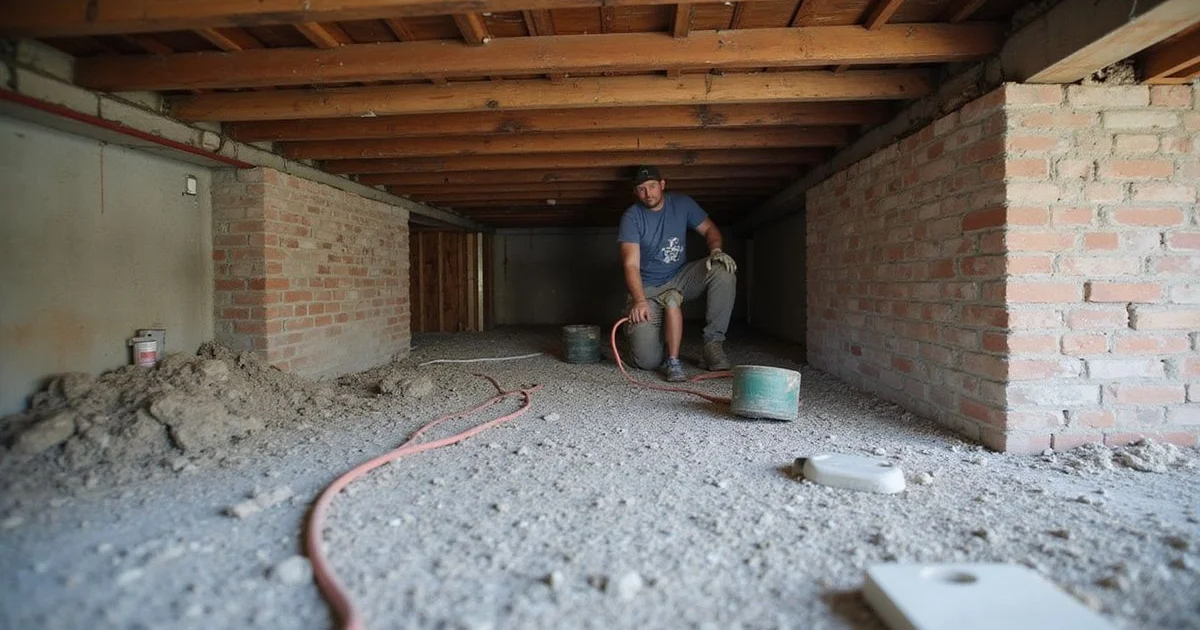
Two different products for two different problems
Walk into a crawl space with a musty smell and a bouncy floor above it and you have two problems, not one. They are related — the moisture probably caused the structural damage — but they need different work.
Confusing them is how homeowners end up with a beautifully sealed crawl space and a floor that still moves, or repaired framing sitting in the same wet environment that damaged the original.
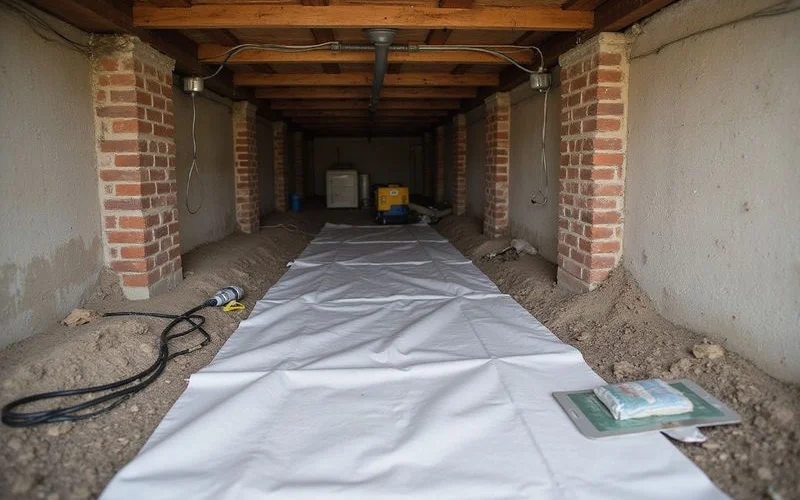
What crawl space repair addresses
Structure. Support posts and their footings, girders and beams, floor joists, sill plates, rim joists, and subfloor.
Symptoms it addresses: floors that sag, dip, or bounce; decayed or insect-damaged framing; settled or deteriorated original piers; over-spanned joists.
What it involves: new footings and adjustable supports, supplemental beams and drop girders, joist sistering or replacement, sill plate repair, and subfloor repair.
What it does not do: change the environment. A repaired girder in a wet crawl space is a new girder in a wet crawl space.
What encapsulation addresses
Moisture. Ground vapor, humid air, and the relative humidity of the space.
Symptoms it addresses: musty odour reaching the living space, high humidity readings, condensation on framing and ducts, elevated wood moisture content, fungal growth, hardwood cupping upstairs.
What it involves: a reinforced vapor barrier over the ground and up walls and piers, sealed seams, sealed vents and access, penetration detailing, drainage where needed, and dehumidification sized to the space.
What it does not do: add structural capacity. Sealing a crawl space does not lift a floor or strengthen a decayed joist.
Why they get bundled, and why we separate them
Contractors frequently quote both together, and on many homes both are genuinely needed. The problem is when they arrive as one number, because then you cannot see what you are paying for each, and you cannot choose to do one now and one later.
We quote them separately for that reason. If the structural work is urgent and the moisture work can wait six months for budget reasons, that should be your decision to make with the numbers in front of you.
When both apply, and the right sequence
Both apply frequently in Middle Tennessee, because the climate produces the humidity that produces the decay that produces the floor movement.
When both are being done, the usual sequence is:
- Resolve standing water and drainage faults, since a liner over water floats.
- Repair framing and supports, while the space is open and accessible.
- Seal and install moisture control, closing up a space whose structure is now sound.
Doing it the other way around means cutting back into a finished liner, which is wasteful and produces a compromised seal.
When only one applies
Repair only. The framing has a structural deficiency — over-spanned joists, a settled pier — but moisture readings are acceptable and the space is dry. Fix the structure and monitor conditions.
Encapsulation only. Humidity is high, odour is reaching the living space, and hardwood is cupping, but framing probes sound and no movement is measurable. Control the moisture before it becomes a structural problem. This is the cheaper, earlier intervention, and it is the one we wish more homeowners made.
How the decision gets made
An evaluation of the accessible crawl space records support and framing condition, wood moisture content, relative humidity, ground conditions, and any bulk water. Our guide on when sagging floors need structural repair covers the thresholds that push the finding toward carpentry. Upstairs, relative floor elevation readings map any movement.
From those findings it is usually clear which scope applies, or whether both do. What it should never be is a bundled recommendation issued before anyone measured anything.
The crawl space repair and crawl space encapsulation service pages explain each scope, including what drives the cost of each.