
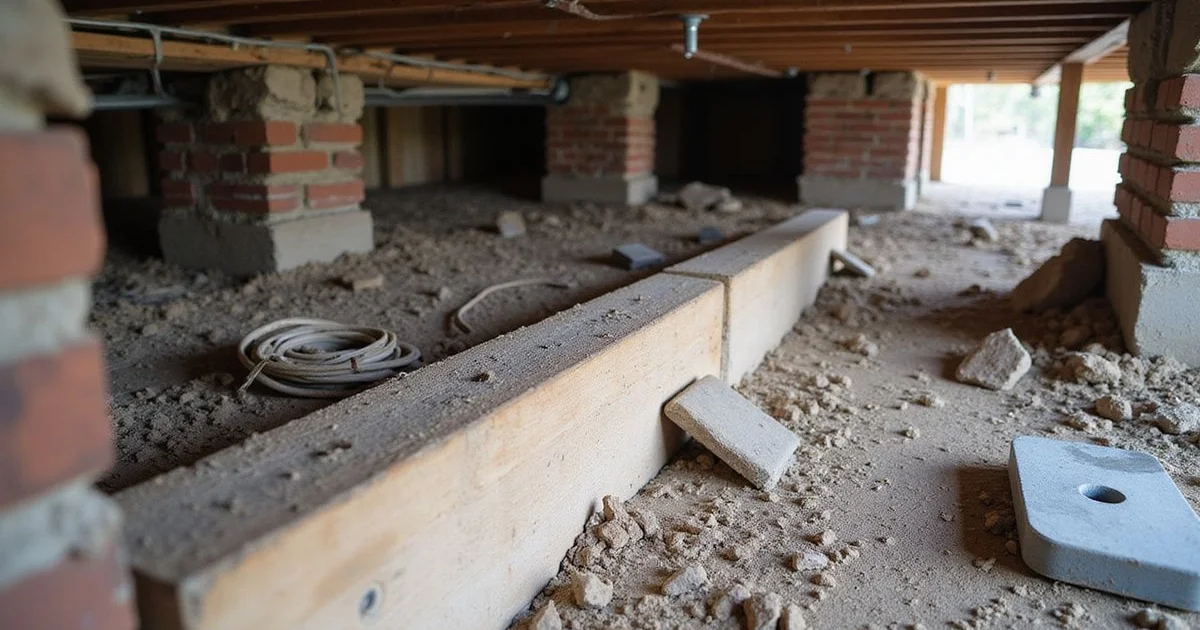
Carpentry, not jacks
Adding a support post under a sagging girder is one kind of repair. Replacing or reinforcing the wood itself is another, and it is the one that applies when the framing has lost capacity rather than simply lacking support.
The distinction matters because a jack under a decayed girder holds a decayed girder up. It does not restore what decay removed.
Sistering decayed or over-stressed joists
Sistering means fastening a new joist alongside an existing one, so the pair shares the load.
When it applies: where a joist has lost some capacity to decay, splitting, or notching, but is still substantially intact and is carrying finishes above that would be disruptive to remove.
How it is done: the new member is cut to bear properly at both ends, positioned tight against the existing joist, and fastened with a fastening schedule appropriate to the loads. Proper end bearing is the part that matters most, and the part most often done badly. A sister joist that does not bear on anything at its ends is decoration.
The limitation: sistering does not fix bad bearing conditions or a failing support below. It addresses the member.
Replacing joists
Where decay is advanced, where a member is broken, or where insect damage has removed too much section, replacement is the honest answer.
The work involves temporary shoring to carry the load, removing the damaged member, and installing a new one with correct bearing at both ends. It is more disruptive than sistering and more expensive, and where a joist is genuinely compromised it is also the only real option.
Supplemental beams and drop girders
Over-spanned joists are one of the most common findings in older Nashville-area homes. The remedy is usually not to replace every joist but to shorten the span they are carrying.
A drop girder is a new beam installed below the joists, running perpendicular to them, with new footings and posts carrying it. Every joist crossing it now spans a shorter distance, which reduces deflection across the whole area.
Sizing matters: beam depth and material, post spacing, and footing size all follow from the load being carried. This is engineering, not an assembly of parts that look strong enough.
Sill plate and rim joist repair
The sill plate sits on the foundation wall and the rim joist closes the floor system at its perimeter. Both sit close to masonry and ground moisture, and both are among the first members to decay in a damp crawl space.
Repair involves shoring the floor system, removing the deteriorated section, and installing a replacement with appropriate treatment and anchoring. It is meticulous work because the load path runs through these members, and because damage frequently extends further than the visible area.
Getting the sequence right
Temporary shoring first, carrying the load safely while members are removed. Then the new member is installed with correct bearing. Then the load is transferred gradually, not all at once.
Gradual matters. A floor that has been deflected for thirty years has finishes above it that have adapted to that shape. Bringing it up quickly cracks plaster, drywall, and tile. Where deflection is being reduced, we do it in stages, sometimes across return visits.
Access changes what is practical
Crawl space height, hatch size, and travel distance underneath affect everything: how material gets in, how long the work takes, and what equipment can be used. An eighteen-inch crawl space with a tight entry is a genuinely different job from a four-foot one.
This is why scopes state access assumptions, and why we walk the space before quoting rather than after.
Where this sits relative to supports
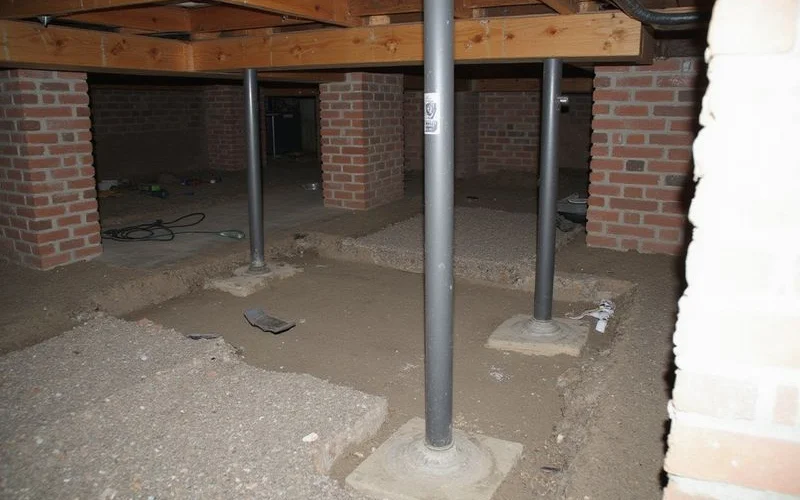
Carpentry restores the wood. Support work — new footings and adjustable posts — carries it. Most projects involve both, and our guide on crawl space support jacks covers the support side.
The crawl space repair service page explains how we assess and scope the whole picture, including where moisture control belongs alongside it.