
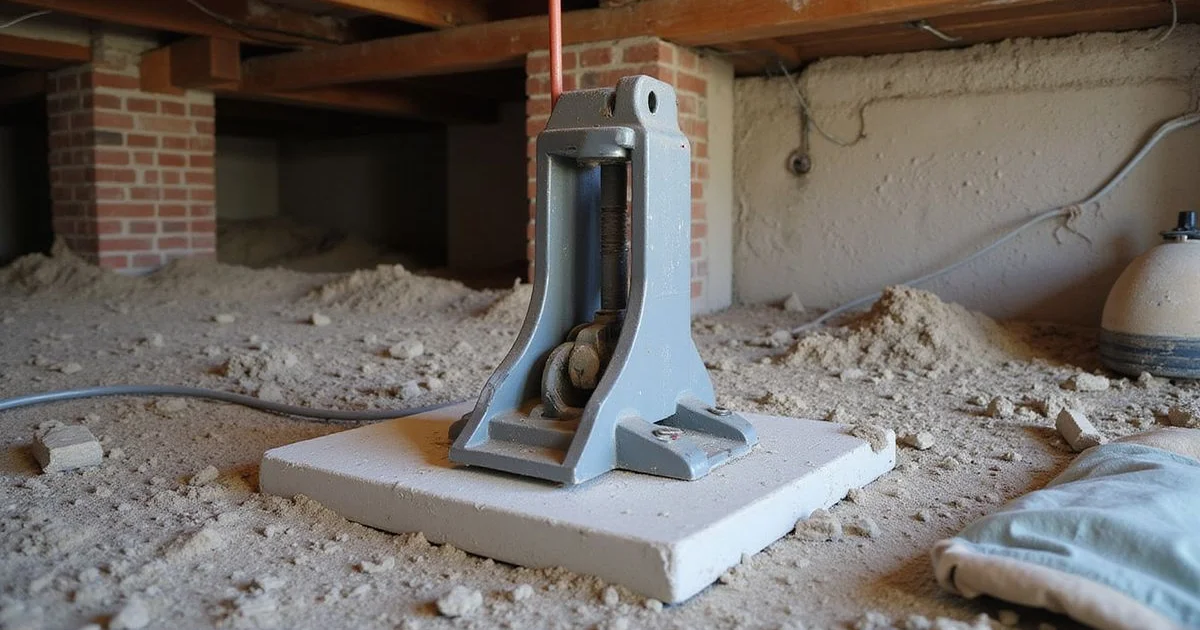
What they are
An adjustable steel support jack is a vertical post with a threaded adjustment mechanism, installed in a crawl space to carry a beam, girder, or floor framing above. Products are sold under various names, but the principle is consistent.
They are used where support is missing, inadequate, or has failed — for example where an original block pier has settled or deteriorated, or where a span never had enough support to begin with.
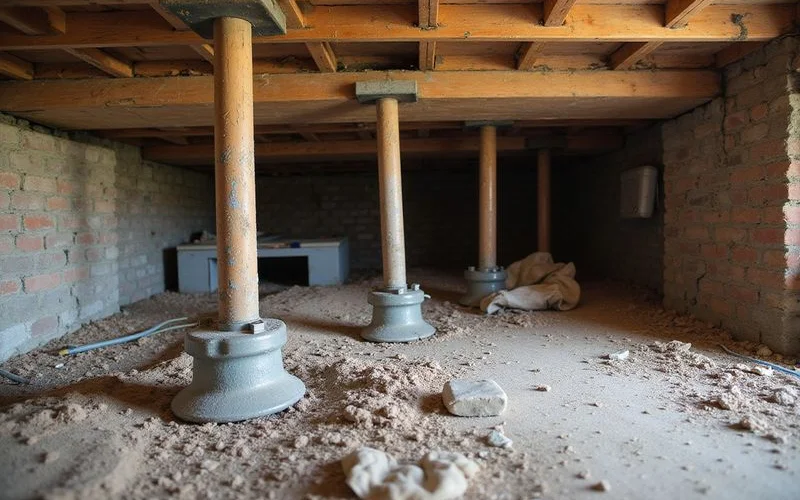
How the load path works
A support jack is one link in a chain, and every link matters.
The framing above carries floor loads to the girder. The girder carries them to the jack. The jack carries them to its footing. The footing spreads them across the soil beneath.
Weakness anywhere in that chain defeats the rest. A correctly sized jack on an inadequate footing will settle. An adequate footing under a jack that does not bear properly against the girder does nothing. And a girder that has decayed at its bearing point cannot deliver load to either.
The footing is the part people skip
The pier pad matters more than the post. A poured concrete footing, sized for the load and bearing on suitable ground, distributes the jack’s load across enough area that it does not punch into the soil.
Jacks set on bare earth, on a pile of loose blocks, or on a cracked slab remnant are a genuinely common finding in Middle Tennessee crawl spaces — typically from an earlier well-intentioned repair. They provide support briefly and then settle, and the floor returns to where it was.
Ask any proposal what footing the jack sits on, and how it is sized.
Reducing deflection, gradually
Where a floor has sagged, jacks can be adjusted to reduce the deflection. Gradually is the operative word.
Finishes above — plaster, drywall, tile, trim — have adapted to the deflected shape, sometimes for decades. Raising a floor quickly cracks them. Careful work adjusts a small amount at a time, sometimes over multiple visits separated by weeks, allowing the structure to accommodate the change.
In some homes, full recovery is not the right goal at all. Where the risk to finishes outweighs the benefit, stabilising the floor where it sits is the better outcome, and that should be stated before work begins.
What jacks do not fix
They do not restore decayed wood. A girder that has lost section to rot is a girder with reduced capacity, supported or not.
They do not address moisture. The condition that decayed the framing continues unless something changes.
They do not substitute for correct span design. Where joists are over-spanned across a wide area, a supplemental beam is the structural answer, not a line of jacks under individual joists.
And they do not make a poorly built floor system into a well built one. They support it.
Our guide on floor joist and girder replacement covers the carpentry side that jacks frequently accompany.
What good installation looks like
Poured footings, sized to the load and bearing on suitable ground. Jacks rated for the load. Correct bearing at the top against a sound member, with appropriate bearing plates. Spacing determined by the beam and the loads, not by eye. Adjustment done gradually and documented. Corrosion protection appropriate to a damp environment.
If moisture control is also planned, the structural work happens first — before the space is sealed, so nobody is cutting into a finished liner afterwards.
The crawl space repair service page explains how we assess supports, framing, and moisture together, and quote them as the separate scopes they are.