
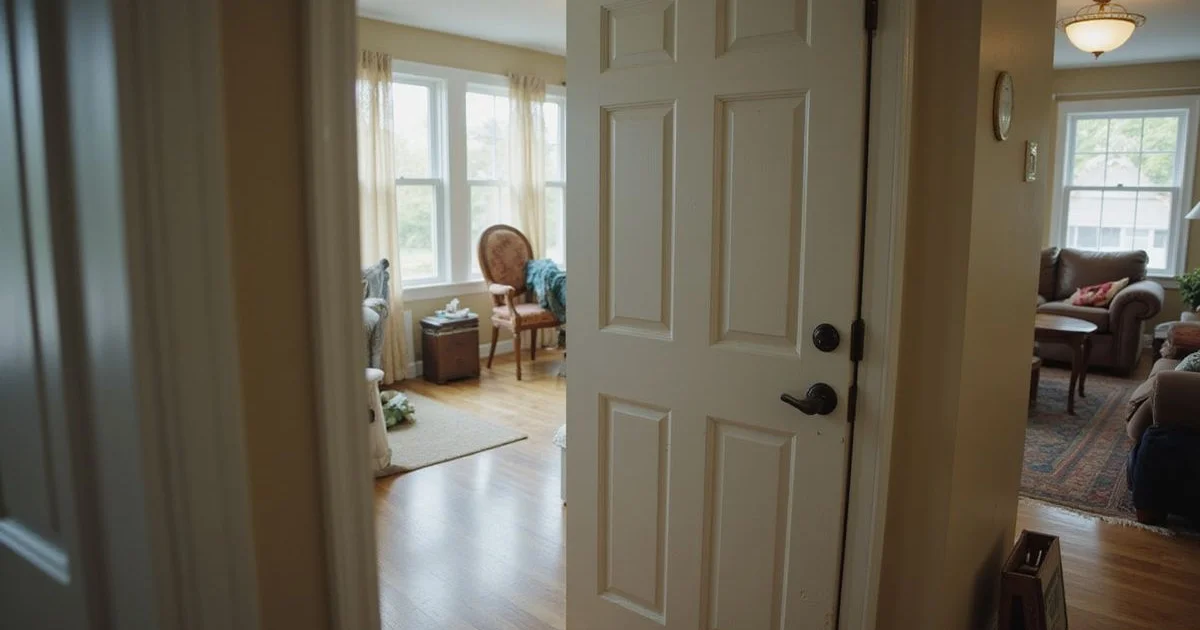
The most misread symptom in the house
Sticking doors appear on every list of foundation warning signs, and they are genuinely one of the better indicators. They are also one of the most ordinary things that can happen to a wooden door in a humid climate.
Middle Tennessee gives you both conditions in abundance, so the useful question is not “is my door sticking” but “which kind of sticking is this”.
How humidity makes a door stick
Wood takes on moisture from the air and expands across the grain. In a humid August, a solid wood door and its jamb both swell, the clearance between them shrinks, and the door drags.
Characteristics of humidity-driven binding:
- It appears in the humid months and eases in winter.
- The gap around the door stays reasonably even; it is simply too small.
- Binding usually shows at the latch edge or across the top.
- Other doors in the house may do the same thing at the same time, spread across different parts of the home.
- It does not progressively worsen year over year.
How settlement makes a door stick
Foundation movement racks the opening. The frame is no longer square, and the door no longer matches it.
Characteristics of settlement-driven binding:
- It persists in every season and typically worsens over time.
- The gap around the door is visibly uneven: tight at one corner, wide at the diagonal opposite.
- The door may swing open or closed on its own if the frame has tilted.
- Binding is concentrated in one area of the house rather than distributed.
- Cracks often appear nearby, particularly diagonally from the upper door corners.
A five-minute diagnostic check
Check the reveal. Close the door and look at the gap around all four edges. Even gap that is simply tight suggests swelling. A gap that tapers — wide at one corner, closed at another — suggests a racked opening.
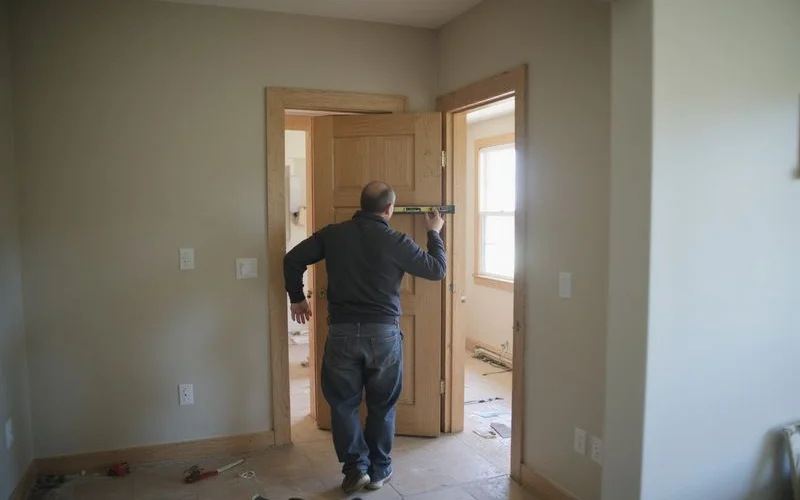
Check the frame for square. Hold a level against the jamb, vertically on both sides and horizontally at the head. A jamb out of plumb and a head out of level together indicate movement.
Check the door itself. A door that is out of square as a panel, independent of its frame, has warped. That is a door problem.
Check the season. Note the month. Check the same door in the opposite season. This is the single most informative test, and it costs nothing but time.
Check the neighbours. Are other doors and windows in that part of the house also binding? Is there cracking in the drywall near the corners? Does the floor slope noticeably in that area?
Companion signs worth looking for
If the cause is structural, the door will usually not be the only evidence. Look for diagonal drywall cracks from door and window corners, separation between trim and floor, stair-step cracking in exterior brick on the same side of the house, and a noticeable floor slope in that area.
A door binding on its own, in one season, with nothing else happening around it, is rarely the start of a foundation project. Our guide on foundation warning signs covers the wider pattern.
When to get it measured
Book an evaluation when binding persists through the dry months, when the reveal around a door is visibly uneven, when several openings in one area are affected, or when cracks and floor slope keep the door company.
A foundation evaluation records relative floor elevations across the accessible area. If the floor under the affected area is measurably low relative to the rest, the door was telling you something real. If the readings are flat, the answer is probably a plane, a hinge adjustment, and a note to check again next February.