
Three tools, one job
All three of these methods exist to stop a basement wall moving further inward. They achieve it differently, and they suit different degrees of displacement and different site conditions.
The decision is not a preference. It follows from a measurement: how far the wall has moved.
Carbon fiber reinforcement
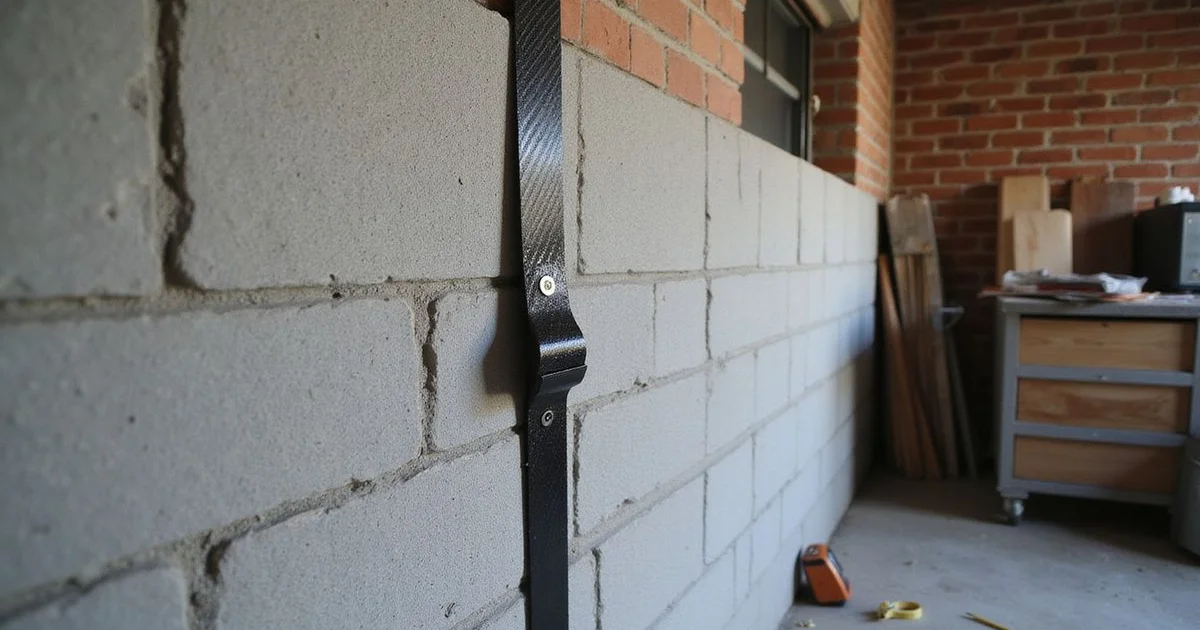
High-strength carbon fiber straps are bonded to a prepared interior wall face with structural epoxy. The system resists further inward deflection by adding tensile capacity the masonry does not have.
Where it fits. Limited displacement, sound masonry with a surface that can be properly prepared, and situations where exterior excavation is not possible or desirable.
Practical advantages. No exterior excavation. Low profile, so the basement stays usable and the straps can be finished over. Typically a quicker installation than the alternatives.
Limitations. It holds a wall where it is; it does not recover position. Bond quality depends on surface preparation, and deteriorated or spalling masonry is a poor substrate. Beyond a certain displacement, it is not the right tool.
Wall anchors and tiebacks
A steel rod passes through the wall to an anchor plate set in stable soil out in the yard, with a wall plate on the interior face. Tightening the assembly applies resisting force.
Where it fits. Greater displacement than carbon fiber suits, and sites where there is accessible soil at the required distance from the wall.
Practical advantages. Tensioning can be adjusted over time, and as exterior soil conditions allow — after a dry period, for example — some position recovery is sometimes achievable.
Limitations. Requires exterior soil access, which rules it out where driveways, patios, additions, or property lines intervene. The installation disturbs the yard. Interior plates are visible.
Steel channel bracing
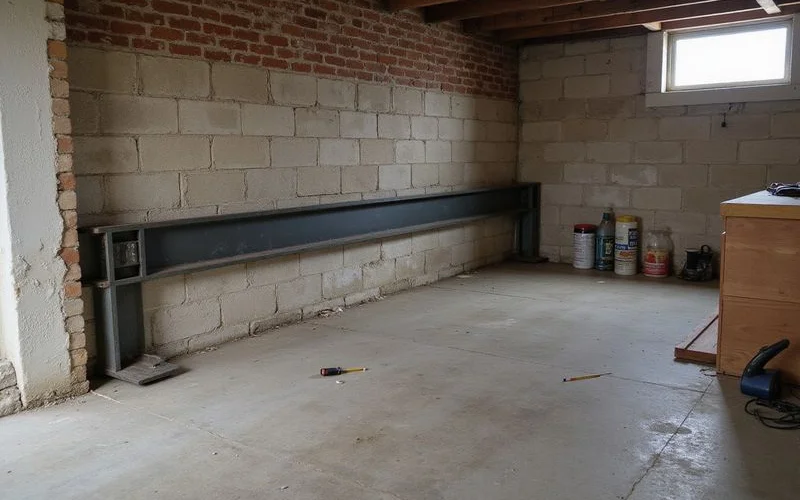
Vertical steel members bear against the interior face and connect into the floor system above and the slab or footing below, resisting inward movement.
Where it fits. Significant displacement, or situations where exterior access for anchors is unavailable.
Practical advantages. Strong, does not require exterior excavation, and installation is generally quicker than anchor systems.
Limitations. The beams project into the room, which affects finished basements. Connection detail at the top and bottom is critical, and that detail is where quality varies between installers.
How the choice actually gets made
Measured displacement. The first and most important input. Limited movement opens the carbon fiber option; greater movement usually closes it.
Wall construction and height. Block, poured concrete, and stone behave differently and attach differently. A taller wall carries more soil load.
Masonry condition. Deteriorated mortar and spalling faces affect what can bond or bear.
Exterior access. Present or absent, and this frequently decides the question on its own.
Whether movement is active. A wall still moving is a different problem from one that moved once and stopped.
Whether recovery matters to you. If some position recovery is a real objective, that narrows the field.
For a head-to-head on the two most common options, see carbon fiber versus wall anchors for bowing walls.
What none of them do
None of these methods removes the load. Expansive clay against the wall keeps swelling; saturated backfill keeps exerting pressure. Stabilization resists it.
That is why a complete plan pairs the structural work with drainage correction — gutters, downspout discharge, grading, and where appropriate exterior drainage. A proposal that never mentions the water is treating the wall as though the soil outside it stopped being a factor.
Getting to a recommendation
The starting point is a measurement of the deflection and a record of whether it is progressing. A basement wall repair evaluation records both, along with the wall’s construction and the drainage conditions outside it, and recommends the method those conditions support — which occasionally is “monitor and correct the drainage” rather than any of the three.