
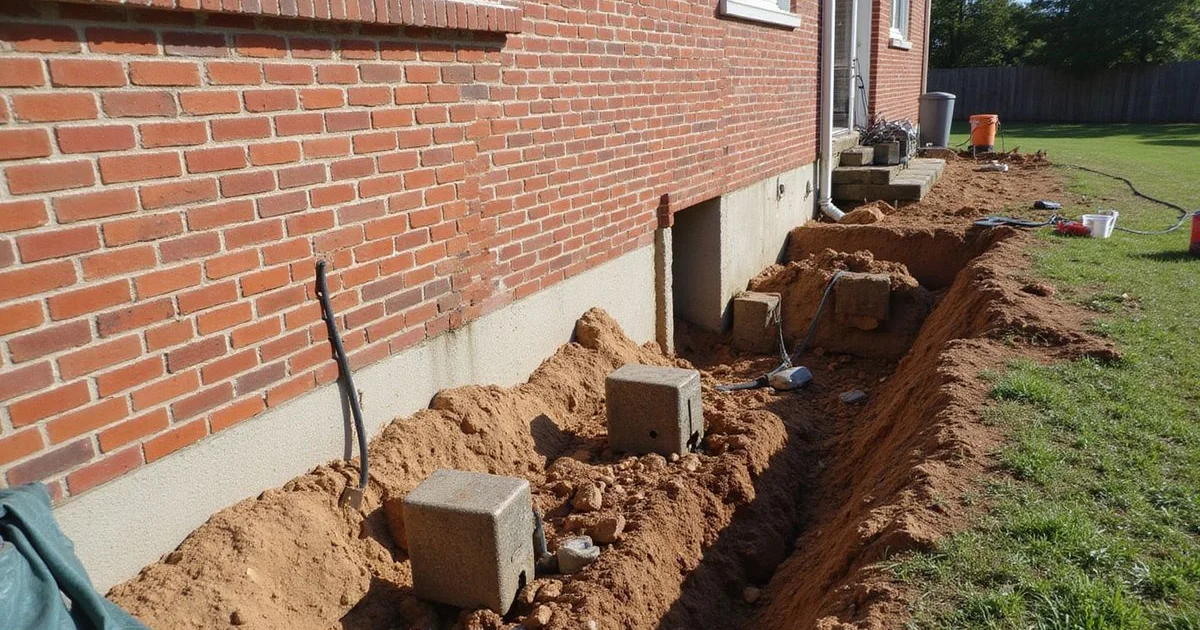
The map of available approaches
Foundation repair is not one technique. It is a family of methods that address different failures, and the useful first step for a homeowner comparing quotes is knowing which family each proposal belongs to.
Broadly there are four: underpinning for settlement, stabilization for wall movement, injection for cracks, and leveling for settled flatwork. They are not alternatives to one another. They address different problems.
Underpinning: for foundations that have settled
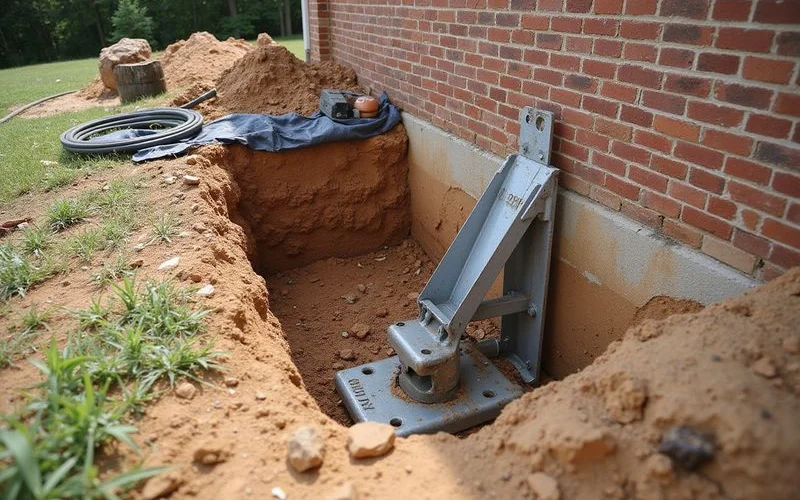
Underpinning transfers structural load from soil that is not adequately supporting it to material deeper down that will.
Push piers. Steel sections driven hydraulically, using the structure’s own weight as reaction, until they reach refusal on load-bearing strata. Suited where competent bearing material exists at a reachable depth and the structure provides adequate reaction.
Helical piers. Shafts with helical plates, screwed into the soil. Capacity comes from the helices bearing in competent soil and is verified through installation torque. Useful where end-bearing depth is impractical or reaction is limited.
Concrete or masonry underpinning. Traditional methods used in specific circumstances, often on older or historic structures.
The choice is a design decision driven by soil profile, depth to competent material, and the loads involved. Our guide on helical piers versus push piers covers the comparison, and the slab foundation repair service page explains how we scope this work.
Wall stabilization: for basement walls that have moved
A basement wall that has bowed or leaned has moved under lateral pressure, and the objective is to stop that movement.
Carbon fiber reinforcement. High-strength straps bonded to a prepared interior face. Suited to limited displacement on sound walls. No exterior excavation, low profile, can be finished over.
Wall anchors and tiebacks. A rod connects an interior plate to an anchor set in stable soil away from the house. Can recover some position over time as exterior conditions allow. Requires exterior soil access.
Steel channel bracing. Vertical members bearing against the wall and connecting into the floor system above. Handles greater displacement without exterior access.
Wall replacement. Where deterioration has gone beyond what reinforcement can responsibly hold, reconstruction is the honest answer. It is an engineered scope.
See wall anchors, bracing, and carbon fiber for how these compare.
Crack injection: for the crack, not the cause
Epoxy injection bonds a crack structurally and is used where the objective is to restore continuity across it.
Polyurethane injection is flexible and expands, and is generally used to stop water entry.
Both are legitimate for the right crack. Neither stabilizes a wall that is still moving. Injecting a crack in an actively deflecting wall stops the drip and leaves the mechanism untouched, which is a distinction worth getting straight before buying one.
Concrete leveling: for flatwork
Settled driveways, walkways, patios, steps, and garage floors are lifted by injecting expanding polyurethane foam through small ports, filling voids and raising the slab in controlled stages.
This is flatwork, not structural repair of the house. It costs a fraction of underpinning and it addresses a fraction of the problem, which is exactly why the distinction needs to be clear in a quote.
Drainage and moisture work, which belongs alongside
Not a repair method as such, but frequently the thing that makes a repair last. Grading, downspout discharge, French drains, interior perimeter drainage, sump systems, and crawl space moisture control all reduce the water that drove the movement in the first place.
A structural proposal that says nothing about where the water goes is incomplete.
Why the method depends on investigation
Every method above has conditions where it is the right choice and conditions where it is the wrong one. Soil profile, depth to competent bearing material, wall construction and height, degree of displacement, load paths, access, and the cause of the movement all bear on the decision.
That is why there is no universal best method, and why a proposal built before measurement should be treated with caution. The engineering question — what is happening, and what will hold it — comes before the product question.
How to use this when comparing quotes
Identify which family each proposal belongs to. If two quotes propose different families, they are answering different questions about your house, and one of them is probably wrong about the cause.
Then look at whether the proposal states the quantities, the design basis, the exclusions, and who is responsible for permits and engineering. Our guide on comparing repair quotes sets out the full checklist.